

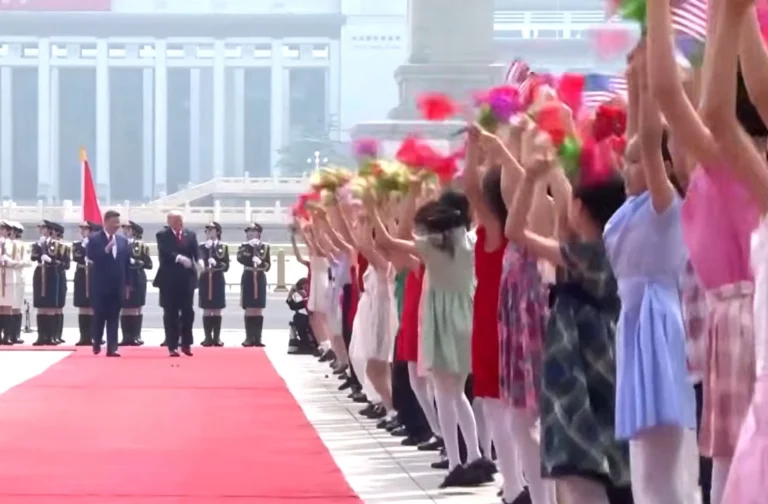
President Trump was defeated by flattery immediately after deboarding Air Force One on his recent trip to China.
President Xi really put on a show, realizing that President Trump could be easily manipulated after giving him a red-carpet cocktail like no other. It worked.
President Trump even noted that his favorite part of the welcome celebration was the children cheering. I was disheartened to hear that. Did he not know why they were cheering that way? Surely, he did.
In case you’re not up to speed on how Communists raise their children, here’s a reminder:
In many communist and authoritarian systems, citizens grow up learning that they must not only obey their leaders but also appear happy about it. From early childhood, schools, youth organizations, and the media work together to shape how children think and feel about the ruling party and its rulers. Textbooks, songs, and classroom slogans often portray the leader as a wise, caring “father” of the nation, the source of all good things in life. Children are taught to show gratitude, pride, and joy whenever the leader or the party is mentioned.
This training is reinforced through ritual. Students may participate in flag-raising ceremonies, recite loyalty pledges, and join carefully choreographed public events where they wave flags, shout slogans, and smile for cameras. Over time, this creates a powerful association: good citizens not only support the leadership but also visibly celebrate it.
In such systems, emotions become a political duty. People understand that frowning, looking bored, or showing indifference in political settings can be dangerous. Praising the leader loudly and often is safe; staying quiet can raise suspicion. As a result, many citizens learn to “perform” happiness in public even if they feel fear, frustration, or hopelessness in private.
It highlights a sobering reality: when a state claims the right to define truth, it will eventually try to control not just what people say and do, but how they appear to feel.
