

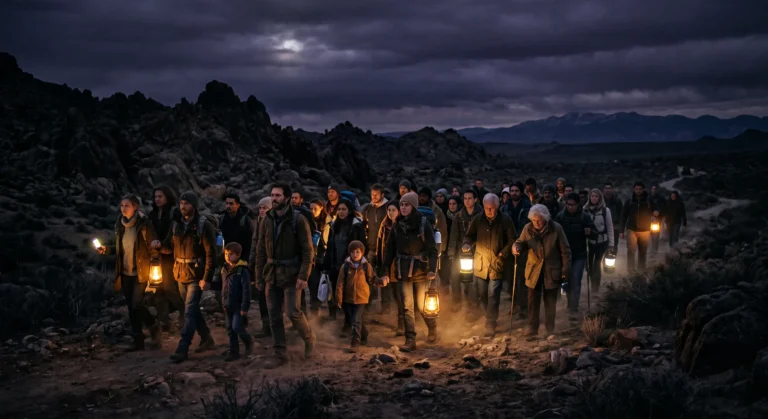
The (New Covenant) Church in the Wilderness
Throughout history, the journey of the Church has closely mirrored Israel’s trek through the Wilderness.
Ever since the New Testament era, Christianity has traveled through a long spiritual wilderness—marked both by seasons of extraordinary light and darkness.
Lessons from the Wilderness
Just as Israel experienced God’s glory crossing the Red Sea, then Tabernacle glory in the desert, early believers on Jesus Christ witnessed Holy Spirit life and power, followed by amazing growth, and God’s continuing favor. Yet, like Israel did, and for the same reasons, the New Covenant Church has suffered self-inflicted wounds due to profound failure, spiritual drift, and moral compromise.
Looking back across the Church Age, we see moments when God revealed His glory in grace and power through many great awakenings, alongside eras of gross darkness when Christianity morphed into various institutions fashioned after the world and lost its way. Every time believers drifted from God’s plain truth, failure followed, new factions were produced, and the world missed the light of God’s glory that He enabled us to shine. But again, through every dark era, God faithfully preserved a devoted remnant.
This parallel between Israel and the Church is a core theme in Scripture:
- 1 Corinthians 10:1–11: The Apostle Paul explicitly connects Israel’s Wilderness journey to the Christian life, stating that Israel’s experiences happened as “examples” (typoi) and were written as warnings for those of us “upon whom the end of the age has come.”
- Hebrews 3:7–4:11: The writer of Hebrews uses Israel’s 40-year wandering and often unfaithfulness, as a direct caution to us, comparing their failure to enter the Promised Land through unbelief with the Church’s unbelief—the kind of unbelief that confesses Him, but that by example, does not really believe what He says.
- Acts 7:38: Stephen explicitly refers to Israel during the Exodus as “the assembly [church] in the wilderness,” establishing a direct spiritual connection between the two people and covenants.
The Dual Reality of the End Times
Scripture reveals that as the Church Age draws to its conclusion, this Wilderness dynamic will become far more pronounced. But rather than blending together, the contrast between light and darkness will intensify simultaneously, giving rise to two distinct Christian entities: an apostate Church and a true, faithful Church.
On one hand, God’s Word explicitly warns of a widespread departure from authentic faith. Paul cautioned that before the return of Christ, a great “falling away” must occur (II Thess. 2:3). Jesus warned that in the last days, “because lawlessness will abound, the love of many will grow cold” (Matt. 24:12). Paul further wrote that “in latter times some will depart from the faith, giving heed to deceiving spirits” (I Timothy 4:1), creating a form of Christianity that maintains an outward appearance of godliness while denying His ever-present power (II Timothy 3:5).
On the other hand, the true Church will shine with purity and power never seen on such a grand scale! Our Lord promised that even the gates of hell would never prevail against His Church (Matt. 16:18), a reference to both Him rising from the dead, and Him building a Church that is both bountiful in number and beauty in glory. As cultural darkness deepens, the faithful remnant will be purified, displaying holy living, bold witness, and genuine love for the gospel, and for others. The body of Christ will become truly one. As the Prophet Isaiah foretold, when darkness covers the earth, the glory of the Lord will arise upon His people (Is. 60:2).
In Summary
The end of the age will not produce a lukewarm middle ground. The division between compromised religion and authentic faith will be sharper than ever before. For believers living in these momentous times, this prophetic reality serves as an urgent call to anchor ourselves in the unchanging Word of God, ensuring our faith rests entirely on Jesus Christ and His faithfulness!
