

How Literary Representations Can Defile Transcendent God
- Widespread Spiritual Deficit: Many modern Christians rely on imaginative fiction, fantasy, and pop culture media rather than Scripture to shape their understanding of God, compromising His transcendent holiness.
- Profanation of Divine Character: Portraying the Almighty through creaturely forms, animal avatars, pagan mythologies, or occult systems violates biblical standards and domesticates an infinite, uncreated Creator.
- Intent vs. Obedience: Emotional appeal or good evangelistic intent cannot justify unauthorized representations of the Trinity, as God demands absolute holiness and obedience over human creativity.
- A Biblical Path Forward: Christian artists and believers must exercise discernment by governing creative expression through Scripture—honoring God’s absolute “otherness” rather than adapting Him to secular entertainment.
Introduction
It’s deeply alarming, though not surprising, how many 21st-century Christians have surrendered spiritual discernment. We’ve allowed carnally inspired books, movies, stage performances, and artistic portrayals to shape our understanding of God far more than the Word of God itself. Few would openly admit that, but it’s precisely what has happened.
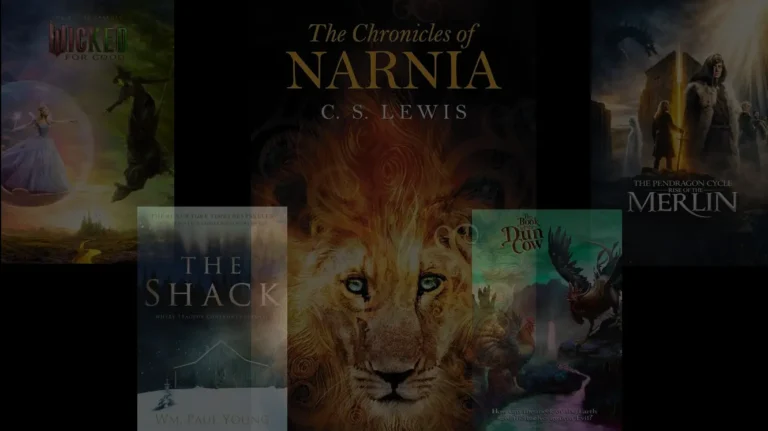
Multitudes of American Christians readily accept almost any image of God—even those that openly profane Him, such as the sorcerer Merlin in The Pendragon Cycle or the witch Elphaba in the film Wicked. So long as a fictional narrative claims to tell “God’s story,” many give it an unqualified pass.
We rarely pause to ask the hard questions: Are these portrayals truly faithful to the revelation He has provided in Scripture? Do they preserve the integrity of His transcendence—His absolute holiness and infinite exaltation above creation? While rare classics like Pilgrim’s Progress stay true to His character and redemptive plan without resorting to cosmic avatars, such works are few and far between.
By the year 2000, I was already using my speaking opportunities to warn pastors and churches: keep your reckless ideas about how to “win souls” in check. Evangelical “harvest” projects had long abandoned the biblical model. Back then, those of us raising concerns were few—isolated voices crying in the wilderness. Yet over the following decades, the Seeker-Sensitive movement spread through hundreds of thousands of churches worldwide, fueling a shallow, gullible, biblically illiterate, and spiritually impotent Church culture.
The core problem isn’t that Christians enjoy imaginative stories or art. The danger arises when fictional portrayals of God and redemption are accepted as though they carry biblical authority. Emotional intensity or artistic sincerity does not make an invented portrayal biblically faithful.
We must carefully differentiate between God’s inspired metaphors and human fiction. When Scripture calls God a “Shepherd,” a “Tower,” or “the Lamb of God,” these are holy and Holy Spirit-inspired images given by God Himself to reveal His character. Major problems arise when uninspired human authors invent creaturely avatars or fictional God-figures to replace His revealed Word.
God the Father is perfectly and definitively revealed in His Son, Jesus Christ. It is impossible to maintain the integrity of Christ—or His revelation of the Father—by filtering Him through a lion, a bear, a cow, an avatar, or a witch. God has never entrusted the definition of His holiness, justice, mercy, or redemptive power to human imagination. Yet in modern Christianity, sentiment continually outranks Scripture. Human imagination overshadows divine revelation, and creative artists are given free rein to rewrite the Bible for modern sensibilities.
True Holy Spirit discernment requires looking past whether a production is inspiring or emotional.
We must ask one foundational question: Is it true to what God has explicitly revealed? When fiction becomes our source of theological truth, the Bible is treated as archaic and dull. We foolishly convince ourselves that we can write a better story than the Almighty.
For centuries, storytellers have used allegory and fantasy to make the divine approachable—casting the Creator as talking animals, mythological deities, or cosmic avatars. While audiences applaud works like C.S. Lewis’s The Chronicles of Narnia, The Pendragon Cycle, or Wicked as faith-building tools, a rigorous biblical examination reveals a dangerous compromise.
My goal is not to condemn believers who have been caught up in these works, nor to claim they are evil. My goal is to shine the clear light of Scripture on the severe spiritual risks involved.
God strongly condemns being misrepresented in His name—whether through mythology, medieval battles, animal types, or witches. God demands absolute transcendence, complete uniqueness, and total separation from creaturely forms. Forcing the infinite Creator into finite, fictional molds does not merely stretch artistic license; it directly defiles the holy, transcendent nature of God. We must stop confusing human creative entertainment with holy divine revelation.
1. The Theological Standard of Holiness and Transcendence
The foundational error of modern Christian media is its failure to grasp the absolute “otherness” of God. God stands entirely alone.
In Hebrew, holiness (qodesh) means to be completely set apart, unique, and uncorrupted by creation. By contrast, the profane (hol) refers to that which is common, ordinary, or worldly. Scripture strictly commands God’s people to maintain this boundary: “And that you may distinguish between holy and unholy, and between unclean and clean” (Leviticus 10:10, NKJV).
When human authors attempt to dress up eternal, immutable divine truth in the garments of human imagination, they commit a form of literary profanation. True holiness requires keeping the sacred strictly separate from the secular toolkit of human storytelling. Through the prophet Isaiah, the Lord asks: “To whom then will you liken God? Or what likeness will you compare to Him?” (Isaiah 40:18). Crossing this boundary reduces the sacred to something common, earthly, and interchangeable. When we make the holy common, we do not elevate culture—we profane God.
2. The Prohibition of Forms and the Danger of Animal Representation
A widespread example of this boundary-crossing is substituting animal forms for the Almighty, as seen in C.S. Lewis’s Aslan in The Chronicles of Narnia or Walter Wangerin’s The Book of the Dun Cow.
While we must distinguish between fictional allegory in fantasy worlds and direct blasphemy, assigning God’s identity to an animal borrows heavily from pagan theriomorphism—a practice historically reserved for Egyptian and Hindu deities, not the God of Israel. This directly confronts the Second Commandment: “You shall not make for yourself a carved image—any likeness of anything that is in heaven above, or that is in the earth beneath, or that is in the water under the earth” (Exodus 20:4, NKJV).
When God revealed Himself at Sinai, Israel “heard the sound of words, but saw no form” (Deuteronomy 4:12, NKJV). This absence of a physical form was deliberate, protecting His divine uniqueness from human distortion.
Portraying God through a majestic lion or a barnyard beast inevitably domesticates Him. It replaces an incomprehensible, sovereign Deity with a fictional character bound by narrative arcs, emotional flaws, and physical limitations. When readers form an emotional bond with a fictional animal, that attachment subtly displaces the true character of the transcendent God. God will never share His glory with a fictional beast.
3. The Mythological Pantheon and the Loss of Exclusivity
Enclosing the divine within pagan frameworks or fictional mythologies—such as J.R.R. Tolkien’s The Silmarillion, The Pendragon Cycle, or Andrew Peterson’s The Wingfeather Saga—introduces the subtle danger of syncretism. Throughout the Old Testament, Israel’s gravest national sin was mixing the worship of Yahweh with the mythologies and religious practices of surrounding pagan nations.
Works like The Wingfeather Saga attempt to convey Christian themes behind a fictional creator named “The Maker,” ruling over a secondary world of strange creatures. By omitting explicit biblical truth and using alternative vocabularies, these stories dilute sacred revelation by wrapping it in secular myth-making. They run headlong into the warning of Romans 1:22–23 (NKJV): “Professing to be wise, they became fools, and exchanged the glory of the incorruptible God into an image made like corruptible man—and birds and four-footed animals and creeping things”.
Placing a “God-figure” at the head of a fictional pantheon reduces the God above all gods to a mere literary archetype, stripping Him of His singular, exclusive supremacy. Mixing divine truth with pagan myth does not make the gospel compelling; it makes it syncretic.
4. Modern Fantasy Tropes and the Blurring of the Occult
The danger reaches a fever pitch for me in secular and speculative media like the film Wicked, where spiritual power, destiny, and redemption are completely detached from biblical truth and tied to witchcraft, magic, and sympathy for the wicked. Scripture strictly forbids dabbling in occult frameworks: “There shall not be found among you anyone who… practices witchcraft, or is a soothsayer, or one who interprets omens, or a sorcerer” (Deuteronomy 18:10, NKJV).
By housing redemption within systems of magic, spells, or wizardry, these works blur the line between the Holy Spirit’s power and forbidden dark arts, training audiences to associate the supernatural work of God with magic.
Modern fantasy routinely subverts biblical symbolism.
In Scripture, dragons and serpents represent Satan and absolute evil (Revelation 12); reframing them as noble or misunderstood characters confuses minds regarding spiritual reality. Proverbs 17:15 (NKJV) warns: “He who justifies the wicked, and he who condemns the just, both of them alike are an abomination to the Lord”. Treating what God calls an abomination as harmless entertainment destroys the moral absolute of His holiness. God’s holy power must never be packaged in the robes of sorcery.
5. Anthropomorphic Trivialization in The Shack
The peak of reducing God to common, earthly categories occurs when human authors attempt to physically embody the Persons of the Trinity, as seen in William Paul Young’s The Shack. While fantasy allegory is an indirect compromise, directly featuring physical actors as the Father, Son, and Holy Spirit enters a much more severe sphere of blatant heresy. In The Shack, the sovereign, unapproachable Godhead is reduced to flawed, overly familiar human actors interacting on a casual emotional level. This literalizes what must remain a sacred spiritual mystery, directly violating John 4:24 (NKJV): “God is Spirit, and those who worship Him must worship in spirit and truth”.
By assigning physical shapes, emotional vulnerabilities, and casual banter to the Father, Son, and Holy Spirit, such works strip away the healthy fear of the Lord and replace it with a human-centric substitute. They drag the King of Kings into the arena of secular psychological therapy. This conditions believers to worship a mental image of their own making rather than the holy God revealed in Scripture. A god who can be contained in human form for therapeutic drama is an idol of human imagination.
6. Intent vs. Execution – The “Golden Calf” Trap
The primary defense of these imaginative works is sincerity: the claim that the author’s intent is to illustrate God’s salvation plan for the human mind. However, God does not grade us on our ingenuity, giftedness, or intentions; He grades us on obedience.
The historical account of Nadab and Abihu stands as a terrifying warning. They offered “strange fire” on the altar of the Lord—which He had not commanded—and were instantly consumed by His judgment. God established an unalterable principle: “By those who come near Me I must be regarded as holy; And before all the people I must be glorified” (Leviticus 10:3, NKJV).
This was the exact trap of the Golden Calf (Exodus 32), where Israel intended to host a feast to Yahweh, yet defiled Him by using an unauthorized creaturely medium. Similarly, the bronze serpent (Nehushtan) was originally a God-appointed sign, but when the people began treating it as a mystical object of reverence, King Hezekiah smashed it (II Kings 18:4, NKJV). While true faith is not opposed to all visual art, artistic expression must never misrepresent or unite what God calls holy with what He calls evil. As Amos 5:14 (NKJV) commands: “Seek good and not evil, that you may live”.
Conclusion
Ultimately, the widespread acceptance and celebration of these imaginative works within 21st-century Christianity points to an alarming collapse of spiritual discernment. The Church has succumbed to a relativistic mindset, operating as if the unadorned gospel of a crucified and risen Savior is insufficient to capture the human heart without theatrical enhancement.
By packaging God within the secular toolkit of fantasy, we drag the sacred down into the common pit of the unclean. So how do Christian artists and writers move forward biblically? The path forward isn’t to ban creativity, but to govern it by Scripture. Works like Pilgrim’s Progress demonstrate that artists can craft powerful allegories about man’s redemptive journey, faith, and trials without ever reducing or bastardizing the unapproachable glory of the Godhead.
If we are to walk in true faithfulness, we must obey the apostolic command: “Come out from among them and be separate, says the Lord. Do not touch what is unclean, and I will receive you” (II Corinthians 6:17, NKJV). God’s holiness is an absolute, uncompromising reality; He must be portrayed with truth, purity, and profound reverence. “God is light and in Him is no darkness at all” (I John 1:5, NKJV).
