

Lampstand Life
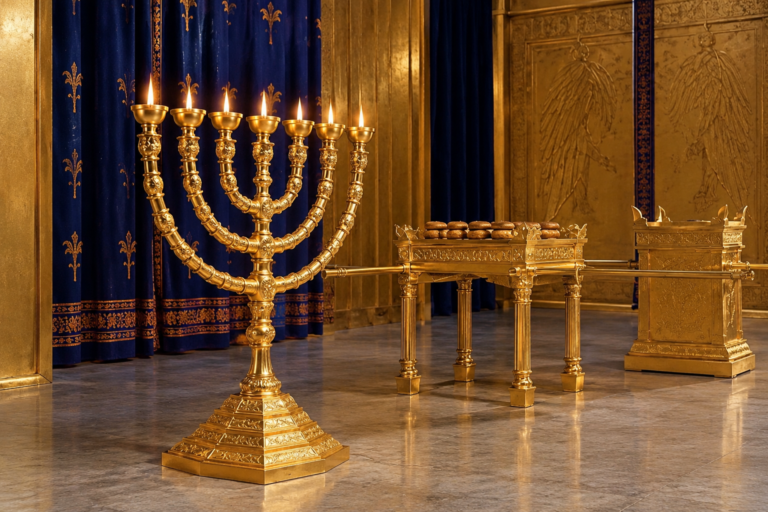
I’d like to point out a few important things about the lampstand in both the Tabernacle in the wilderness and the Temple in Jerusalem, and how they relate to our lives as God’s lights in the world as members of the New Covenant.
Exodus 27:20 reads: “And you shall command the children of Israel that they bring you pure oil of pressed olives for the light, to cause the lamp to burn continually.”
God told Israel to bring pure oil from pressed olives and to keep the lamps burning continually. This sacred responsibility pictures what God desires for every follower of Jesus Christ and every local church.
Pure Oil is Needed—Not Human Ingenuity or Effort
Impure oil smokes, sputters, and can dim a flame. Pure oil burns brightly. We can grieve the Holy Spirit through sin, hindering our witness. God desires us to walk in purity so that our lives can shine with His glory.
The lampstand illuminated the area where the priests carried out their duties. In a very real sense, its light also represented the presence of God. Notice what the Apostle John writes about Jesus as the Light:
- John 1:4: “In Him was life, and the life was the light of men.”
- John 1:5: “And the light shines in the darkness, and the darkness did not comprehend it.”
- John 1:9: “That was the true Light which gives light to every man coming into the world.”
- John 8:12: “I am the light of the world. He who follows Me shall not walk in darkness, but have the light of life.”
- John 12:46: “I have come as a light into the world, that whoever believes in Me should not abide in darkness.”
- I John 1:5: “God is light and in Him is no darkness at all.”
To those who believe in Him, Jesus said: “You are the light of the world. A city that is set on a hill cannot be hidden. Nor do they light a lamp and put it under a basket, but on a lampstand, and it gives light to all who are in the house. Let your light so shine before men, that they may see your good works and glorify your Father in heaven” (Matt. 5:14–16).
Paul writes that believers shine as lights in a crooked generation (Phil. 2:15). Jesus told the story of the foolish virgins, who discovered they were in trouble when their lamps went out (Matt. 25:1–13). Paul’s warning not to quench the Spirit (I Thess. 5:19) reminds us that our light is meant to keep shining.
Throughout Scripture, oil is used as an image of the Holy Spirit. One outstanding example is Zechariah’s vision of the lampstand in chapter four.
Zechariah was a prophet, and Zerubbabel was the governor leading the returned exiles in rebuilding the Temple. The task seemed overwhelming to the people, but God assured them it would be accomplished—not by might or power, but by His Spirit (Zech. 4:1–6).
God gave Zechariah a vision of a lampstand supplied by two olive trees, with oil flowing into the lamps. Through this imagery, God made clear that He is the provider and the one who builds His house—then and now. The lampstand’s light did not depend on human effort, strength, or talent. It depended on a continual supply from God.
In the same way, followers of Jesus Christ do not produce their own light. We shine because the Spirit fills and enables us. As we walk in purity and depend on Him, our light shines more steadily.
God is conforming us to the image of His Son, who is perfectly pure. We will not be fully like Him until we see Him, and our spiritual growth into His likeness is ultimately His work. Still, we must be willing to keep our vessels pure.
Jesus blessed the pure in heart (Matt. 5:8). David asked God to create in him a clean heart (Ps. 51:10), and Paul instructed Timothy to love from a pure heart and sincere faith (I Tim. 1:5).
In Revelation 1:20 and 2:5, the churches are represented as lampstands. Jesus warned that a lampstand could be removed if a church abandoned its first love. He still walks among the lampstands, and every church that belongs to Him is accountable to Him.
Oil from Pressed Olives
Olives yield oil when they are pressed or crushed. This was the typical way to extract olive oil, but there is room for a spiritual type here.
God’s Word does not teach that He desires to crush believers, but it does speak of being broken before Him. These are different images. When we fall upon Jesus, we are broken; those who refuse Him will be crushed when judgment comes (Luke 20:18).
The Bible also teaches that trials can refine our faith and that Christ’s strength is made perfect in our weakness (I Pet. 1:6–7; II Cor. 12:10). God does not delight in our pain, but He can use it to deepen our faith and make us more like Christ. We should not seek suffering; but as we face the challenges of life, God can help us stand and grow through them.
Isaiah’s prophecy of the suffering Servant speaks of his being “bruised for our iniquities…” (Isa. 53:5, 10). The writer of Hebrews tells us that Jesus was “made complete” through His suffering.
“Though he were a Son, yet learned he obedience by the things which he suffered; And being made perfect [complete], he became the author of eternal salvation unto all them that obey him” (Heb. 5:8-9). And Gethsemane, where Jesus agonized in prayer, means “oil press” (Matt. 26:36–39). The similar imagery here is too strong to ignore.
Paul described being hard-pressed on every side, yet not crushed, so that the life of Jesus might be seen in us (II Cor. 4:7–10). God told Paul that His strength was made perfect in Paul’s weakness (II Cor. 12:9). Peter says that trials refine faith like gold tested by fire (I Pet. 1:6–7), and Romans 5:3–5 teaches that suffering produces perseverance, character, and hope. Our trials are not wasted; God can use them to strengthen our faith and keep our light shining.
So, the lampstand teaches us to burn continually and to burn purely, depending on God through every trial. When we walk with Jesus, the Spirit enables us to shine in a dark world—not for our glory, but so that others will glorify the Father.
