

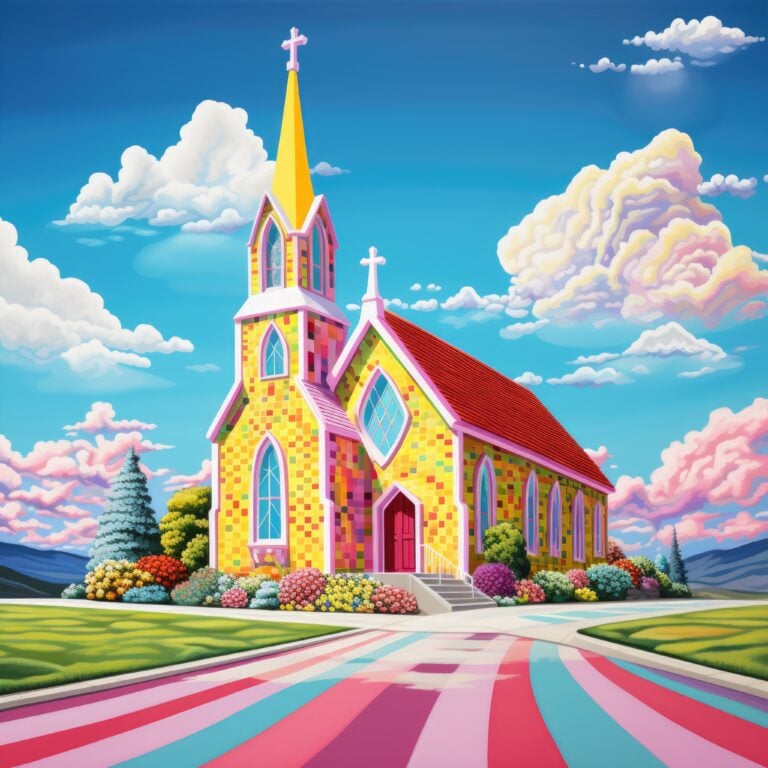
Designer Christianity
A profound distinction exists between some (not all) modern American Christianity and the faith of the New Testament era.
The contrast between the lifestyles of the average Western believer and early Christians is stark, to say the least. We live in two completely different worlds.
American Christians have designed and constructed our own custom version of the Christian life around our culture. Design-build Christianity has happened in every culture and in every generation.
I was a design builder for several years in the eighties and early nineties, when I built commercial buildings of various types, shapes, and sizes throughout the Southeastern US. Every building I constructed had one thing common to all — a concrete foundation. From there up, I used various materials to build the body of the building, such as wood, metal, block, brick, concrete, insulated panels, etc. The foundation was always the same, but the body was always different. Each building from the concrete up was designed to meet the desires of the owner for whom I was building.
Not a Literal Building, but a Spiritual House
Not long after I began preaching in local churches scattered throughout South America, I could see, more than ever before, how we Christians have built our churches the same way that I built buildings years prior.
They were all design-built churches. And today is no different, just new designs. All the Foundations were the same, who is the Person and work of Jesus Christ; but from there up, each one had his own idea about how he wanted the body to look and function on that Foundation.
The Apostle Paul said that he was “a wise master builder,” and that he “laid the foundation,” who is Jesus and His gospel; but each one should take care how he builds on that Foundation (I Cor. 3:9-17).
At the end of the age, whatever was built on that foundation would be tested by fire. All things that could be consumed by fiery trials would be consumed (wood, hay, and stubble), but whatever is not consumable by fire would remain (gold, silver, and precious stones).
The wood, hay, and stubble represent our ideas built on the foundation of Jesus, and the gold, silver, and precious stones represent what His Spirit built using us as His instruments to do so. The latter is what God requires for His manifest presence and power to be expressed, resulting in a truly mature, fruitful body of believers (I Cor. 12-14). The former grieves the latter, hindering and oftentimes making it impossible for God to build a truly Spiritual House because His Spirit is quenched (Eph. 4:30; I Thess. 5:19).
The local churches of North America were built by the same methodology as those in South America, and the churches of the UK by the same methodology, and of the Middle East, and of Asia, and of everywhere else except for those places in the world where constructing the body by personal design is not an option.
When options for building the body are narrowed down, personal-preference designer churches are few and far between, and in some countries, non-existent. In those places, only a Spiritual House can be built.
Many years ago, the Holy Spirit gave me a single statement to punctuate what I just explained: “Wherever Christianity has room to roam, it will eventually become man’s Christianity.” And that’s the truth. Consequently, we have what we have today—LOTS more wood, hay, and stubble than gold, silver, and precious stones.
Designer Lifestyles
But our problem is not limited to our designer churches but also includes our designer lifestyles.
Think about it.
Our understanding of the believer’s life and lifestyle as set forth by the American Church and by the underground churches in China, for example, is miles apart. We’re not even close.
We both cannot be right. The gospel and the lifestyle that it affords us does not change between cultures. That statement is a lot for us to swallow. But is it not true?
And there should not be any question about whether the underground church in China follows the New Testament more closely than we do.
We have the liberty to do whatever we choose with our lives, and they don’t—at least not nearly to the extent that we do. They can’t even practice their faith openly.
The broad liberties that we have really makes it easy for us to bend New Testament Christianity way out of its original shape. It’s like choosing a particular paint color from a color chart index in a paint store—too many choices! And when we can choose whatever color we want, we’re going to choose whatever color we prefer. And we all prefer something different.
We do this with our Christianity, whether it’s the way we build the local church body on the Foundation of the same Jesus, or the way we interpret how that same Jesus would have us to live. And when we find a larger community of believers with whom we generally agree, we get together and feel approved, approving each other.
There’s real danger here, saints. REAL DANGER! Because central and unavoidable to the gospel is dying to self—literally—not figuratively. The Apostle Paul said that when we identify with Jesus Christ’s own death, our earthly man died with Him; and when He rose up out of the grave, our “new man” rose with Him.
Jesus said that unless a kernel of wheat falls and dies in the ground (John 12:24), it will not come up out of the ground and produce fruit. He went on to say that whoever saves his life will lose it, but whoever loses his life for His sake will find it (Luk 9:24). He also said that we must take up our cross daily and follow Him, or we are not worthy of Him (Matt. 10:37-38). And concerning being confidently prepared to meet Him when He returns, He said for us to pray that we may be counted worthy to stand before Him.
“Watch therefore, and pray always that you may be counted worthy to escape all these things that will come to pass, and to stand before the Son of Man” (Luke 21:36).
Nothing in any of that leaves room for us to live a designer lifestyle to suit our preferences. Nothing. And the revelation Paul received on the way we “do church,” if we would see Jesus to the full, doesn’t have any room for preference either. Yet almost everything we do is by our own design. Lord, have mercy on us!
We Live an Americanized Gospel
Our adaptation to what has long been an Americanized gospel evolved through a slow, systemic blending of biblical language with the values of our surrounding culture—specifically these three:
- individualism,
- consumerism, and
- the American Dream.
Most of us badly need to shift our focus, and quickly, in view of the lateness of the hour!
Notice the following ways we “do Christianity” in America compared to how the Early Church did:
1. From Surrendered Lives to Risk-Free Living
- The New Testament Reality: First-century believers faced intense social ostracization, economic hardship, and systemic persecution (Heb. 10:32–34). Following Jesus required leaving nets (businesses), homes (family), and sometimes even dying as a martyr. Faith was inherently risky, defined by a willingness to lose everything for the sake of the Kingdom of God.
- The American Design: The American version of the Christian life heavily prizes safety and security, predictability, comfort and convenience. Following Jesus in America is often framed as a way to enhance peace of mind, marriage stability, and personal happiness, rather than a call to be a living sacrifice for His glory.
2. From Community Bonding to Consumer Shopping
- The New Testament Reality: The Early Church was a tight-knit, interdependent counterculture. In Acts chapters 2-4, believers pooled their resources to care for believers in need, shared house-to-house meals, and viewed their lives as entirely bound to one another. It was first and last relational.
- The American Design: American Christianity views the Church primarily through a consumer lens. Churches function like religious retail centers, and Christians act as consumers. Believers “shop” for a congregation based on personal needs or preferences: the quality of the children’s ministry, the style of the worship music, the parking situation, or the charisma or scholarship of the lead pastor. If a church stops meeting a family’s individual needs or desires, it is perfectly acceptable to simply pack up and move to a Church competitor down the road.
3. From Sharing in Love to Self-Love
- The New Testament Reality: The New Testament epistles are written almost exclusively in the plural (“you all”). Identity was found corporately within the body of Christ. Wealth was viewed as a gift for generous sharing. Blessings beyond one’s own needs were channeled outward to help others according to the Spirit’s leadership (very important to have the Spirit’s leadership on sharing) and to fund the mission of the gospel and other areas of the furtherance of His kingdom in the world.
- The American Version: American culture is hyper-individualistic, and biblical Christianity has been redesigned to match. Most of us live for self. I don’t know how to say it any plainer, saints. I’ve seen it everywhere I’ve been. It’s not unique to us, but Americanized Christianity is unique to America—and so much of what we do is not Early Church Christianity, nor is it the Spiritual House and Spirit-led life that God desires. Our faith is in many ways of the mind only, and it has not gripped our whole life; for example, we think of Jesus as a “personal Lord and Savior,” which He is that, but we cannot personalize Him into our own fashion. Millions of us have created our own “Jesus.”
How Did This Happen?
When Christianity became legally protected and eventually institutionalized in the West centuries ago, the Church shifted from being a persecuted, underground movement resulting in a truly Spiritual House, filled with Spirit-led believers, to the establishment we have here and all over the world.
In our case, in America, our liberties were supercharged by the rise of capitalism and the pursuit of the “American Dream.” Over generations, a subtle theological sleight-of-hand took place. The promises of eternal, spiritual abundance and “power from on high,” found in the Spirit-filled life in Christ were subtly swapped for material, earthly abundance. As I’ve said for many years… in many ways, we resemble an Old Covenant Church more than a New Covenant one.
We’ve created a “nice, middle-class Jesus”—one who affirms our personalized ambitions, and who would never call us to actually exchange our securities and comforts to take up a cross.
What To Do Now?
If the Holy Spirit is convicting you, showing you ways and means that you practice Christianity that are not compatible with biblical Christianity, ask our Heavenly Father to forgive you and for His Holy Spirit to realign your thinking with the plain teaching of God’s Word. Ask Him daily to help you be truly transformed by the renewing of your mind and conform to the image of His Son.
My message through this article is not meant to condemn anyone, to falsely accuse anyone, and certainly not to induce paralyzing guilt; but rather, it is an invitation to real repentance and spiritual revival. We all need it, brothers and sisters. We all do. Not one of us has arrived at perfection. We all have room for improvement.
Probably every one of us, in one way or the other, needs to be untangled from the American-Dream gospel of comfort and convenience, to break free from consumer Church mentality, and to ask ourselves whether the way we do Church and the way we live our lives run parallel with God’s Word as it is written.
He’s already begun cleansing work in His House. Let us by all means and with all our hearts let Him work!
