

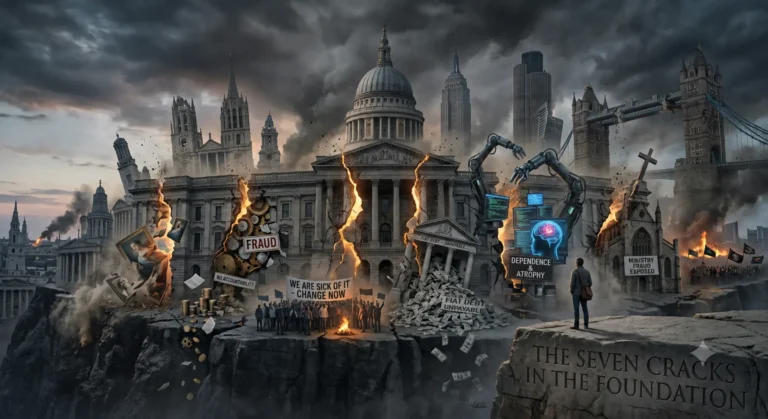
Seven Cracks in the Foundation – There are Many More: Why Modern Civilization Stands at a Precipice
Modern civilization often presents itself as the pinnacle of human achievement—a hyper-connected, technologically advanced society operating at unprecedented speed. Yet beneath this surface of prosperity, structural fractures are widening. The primary danger facing the world today is not a single catastrophic event, but rather the simultaneous convergence of decay across culture, governance, economics, technology, and faith. When examined together, seven distinct developments suggest that the world as we have known it is entering an unprecedented period of instability.
1. The Collapse of Western Culture
For centuries, Western culture provided a bedrock framework grounded in individualized rights, objective truth, institutional trust, and shared civic responsibility. Today, that cohesion is unraveling. Shared cultural narratives have fragmented into tribal polarization, where common foundational values are increasingly discarded in favor of hyper-individualism and ideological conflict. As cultural foundations weaken, societies lose the internal cohesion required to navigate complex global challenges.
2. Institutionalized Corruption and the Erosion of Accountability
Confidence in global governance has reached a historic low. Across both democratic and authoritarian models, political systems are widely perceived as compromised by self-interest, financial fraud, and systemic corruption. A critical factor driving this disillusionment is the dynamic of selective enforcement: while ordinary citizens face strict regulatory compliance, high-profile figures and entities implicated in major financial or political scandals rarely face meaningful consequences. This dynamic undermines the core principle of the rule of law.
3. Public Exhaustion and Inevitable Civil Upheaval
Decades of stagnant living standards, institutional decay, and unaccountable leadership have pushed populations worldwide to a breaking point. The general public across geographic and political spectra exhibits deep-seated fatigue and resentment. History demonstrates that when large segments of a population conclude that traditional systems no longer represent their interests or offer avenues for peaceful redress, civil unrest and populist upheavals become inevitable outlets for systemic frustration.
4. The Fragility of Global Fiat and Unsustainable Debt
The global financial architecture operates on fiat currency—money backed not by physical commodities, but by government decrees and public trust. Concurrently, sovereign debt levels among major and minor economies have reached unprecedented heights that mathematical projections suggest can never be repaid through standard means. This structural reliance on continuous debt expansion leaves the global economy vulnerable to severe inflationary pressure, currency debasement, and systemic default risks.
5. High-Tech Over-reliance and the Atrophy of Human Ingenuity
The rapid integration of artificial intelligence, automated robotics, and massive data infrastructure is fundamentally altering human cognitive habits. As societies defer research, analytical reasoning, and creative problem-solving to algorithmic machines, a critical dependency emerges. This rapid transition risks the atrophy of core human ingenuity and critical thinking capabilities, leaving populations vulnerable to widespread automation shocks and a loss of intellectual self-reliance.
6. The Crisis of Authority and Faith in the Church
Religious institutions have historically provided moral consensus and spiritual continuity. However, high-profile exposures of financial misconduct, moral hypocrisy, and ethical breaches among prominent pastors and international ministry leaders have severely damaged public trust. The resulting decline in Christian faith reflects a broader breakdown of spiritual and moral authority, leaving a cultural vacuum in societies that once relied on those shared frameworks for social stability.
7. Rising Extremism and Geopolitical Volatility
Geopolitical friction is intensifying as radical ideologies and antisemitism experience a significant global resurgence. This escalation heightens tensions across sensitive regions, particularly the Middle East, while destabilizing international security frameworks. As ideological extremism fills the void left by failing diplomatic institutions, the threshold for regional conflict expands, creating widespread ripple effects across global trade, migration, and international security.
Conclusion
These seven pressures do not exist in isolation; they reinforce one another. Economic instability fuels public unrest, institutional corruption accelerates cultural decay, and technological over-reliance weakens the human capacity to resolve complex geopolitical and moral dilemmas. Addressing these challenges requires a clear-eyed assessment of the foundational vulnerabilities threatening modern global order.
