

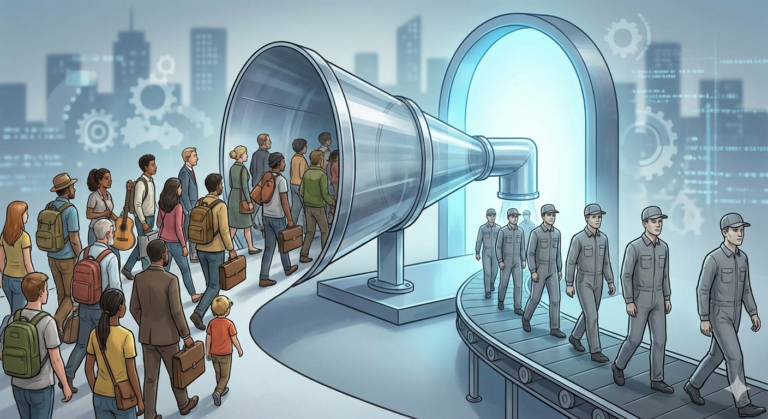
WELCOME TO THE CLONE AGE
HOMOGENIZED MINDS
We are in an age when artificial intelligence is already touching every facet of our lives—a period defined by the funneling of human thought, creativity, and behavior through AI-driven information.
Today, billions rely on AI algorithms for news, opinions, literature, art, writing, music, etc., and even for personal advice.
These systems, trained on vast datasets, regurgitate synthesized knowledge, often amplifying echo chambers.
Social media feeds, search results, and chatbots like Grok, ChatGPT, Perplexity, Gemini, and many more like them deliver uniform responses, retooling our minds to a synchronized collective. In all, there are more than 90,000 AI platforms today!
The result?
A society of “cloned” minds—deriving our info from the same channels, reacting predictably, and innovating less authentically.
Almost gone is our personalized, artistic, organic, and humanly inspired generation.
And unlike the Stone Age, which led us forward beginning thousands of years ago, when man had to use his ingenuity, creativity, sweat, and tears to literally chip his way out of antiquity into the modern age of comfort and convenience, the AI Clone Age is driving us backwards at an alarming pace.
Back then, we were driven by our need and desire to build for the better.
Now that “we’ve arrived,” we are driven by an intellect gone completely mad, driving us to our doom!
We’ve been told by the brightest and best among us that AI and robotics are advancing at such a rapid pace that, in the not-too-distant future, we’ll all have:
-
A universal income
-
Universal pleasure
-
And be required to do nothing for it
Who can imagine a world where no one is responsible for his or her own well-being?
That’s not a utopia that rational-thinking people wish for, but rather only “mad scientists” do!
At the rate we’re going, we’ll soon cycle back to the Stone Age, but this time around, we won’t be able to chip our way out!
The Clone Age is going to bring the death of us all!
Consider the following supporting stats:
AI-GENERATED SONGS
- Approximately 7 million AI-generated songs are produced daily, primarily driven by platforms like Suno, which generates music at a scale equivalent to Spotify’s entire catalog every two weeks.
- Suno’s internal data shows users creating about 7 million tracks daily through text prompts, fueling rapid growth despite copyright lawsuits.
- Deezer reports 20,000 to 50,000 fully AI-generated tracks uploaded to its platform each day, representing 18-34% of total uploads.
AI-GENERATED BOOKS
- A single AI-powered publisher produced 9,175 books from August, 2024, to October, 2025, averaging 21 per day across diverse topics like math and psychology, often without AI disclosure.
- Amazon limits self-publishers to 3 books per day to address AI-generated content floods, though overall self-publishing exceeds 1.4 million titles per year on Kindle, with unclear AI portions.
- Global book publishing reaches 11,000 daily (4 million yearly), but AI-specific estimates remain anecdotal, with few beyond outlier publishers.
AI-GENERATED ART
- AI generates images and texts mimicking human styles, flooding platforms with replicas—all fake.
- Approximately 34 million AI-generated images are produced daily across major platforms like Midjourney, DALL-E, and Stable Diffusion.
- Over 15 billion AI images have been generated since 2022, with platforms like Adobe Firefly alone contributing 7 billion since 2023.
- Stable Diffusion accounts for about 80% of all AI-generated images to date, fueling massive daily volumes that outpace human photography milestones.
- AI tools excel at mimicking fine art styles (e.g., oil paintings, surrealism), but the vast majority of daily output serves marketing, social media, or prototyping rather than curation as “fine art.”
- Galleries and auctions feature select AI pieces (e.g., via Christie’s), yet no data isolates daily fine art production amid the 34 million total.
AI EDUCATION AND WORK
In education and work, students and professionals rely on AI for essays and reports, eroding unique perspectives and bypassing the exercise of the mind, including critical thinking.
Even politics and culture suffer, as viral AI-curated content polarizes yet standardizes discourse.
This Clone Age stifles human ingenuity, turning us into digital echoes.
Creativity, ingenuity, and critical thinking—the exercise of the mind in general—are fading fast.
The list of industries under the heavy influence of AI today goes on and on. It has already permeated every sector of society, and while there are many advantages, if it leads to the enslavement or death of us all, as Singularity strongly suggests, the potential pitfalls quickly outweigh all the good it can possibly do.
WE’VE HIT THE PROGRESSION-DIGRESSION CURVE.
After six thousand years of advancement in science, technology, and knowledge in general, we’ve reached that imaginary curve where we’re racing to undo all progress made.
It seems that we couldn’t be much more than one more algorithm away from reaching the point of no return!
Our only hope is not here but with the One who has risen from the grave, ascended to His Father, and prepared a place for all those who will call upon Him to be saved.
